.png?width=750&height=300&name=SITERA%20CONSULTING%20(Logo).png)

Search has changed. Today's buyers use AI tools like Google's Search Generative Experience (SGE),...
Sales and marketing can agree on lead definitions, meet every week, and share dashboards while revenue still misses plan. The problem is not necessarily that alignment failed. The teams may be perfectly aligned around activities that do not create enough qualified revenue.
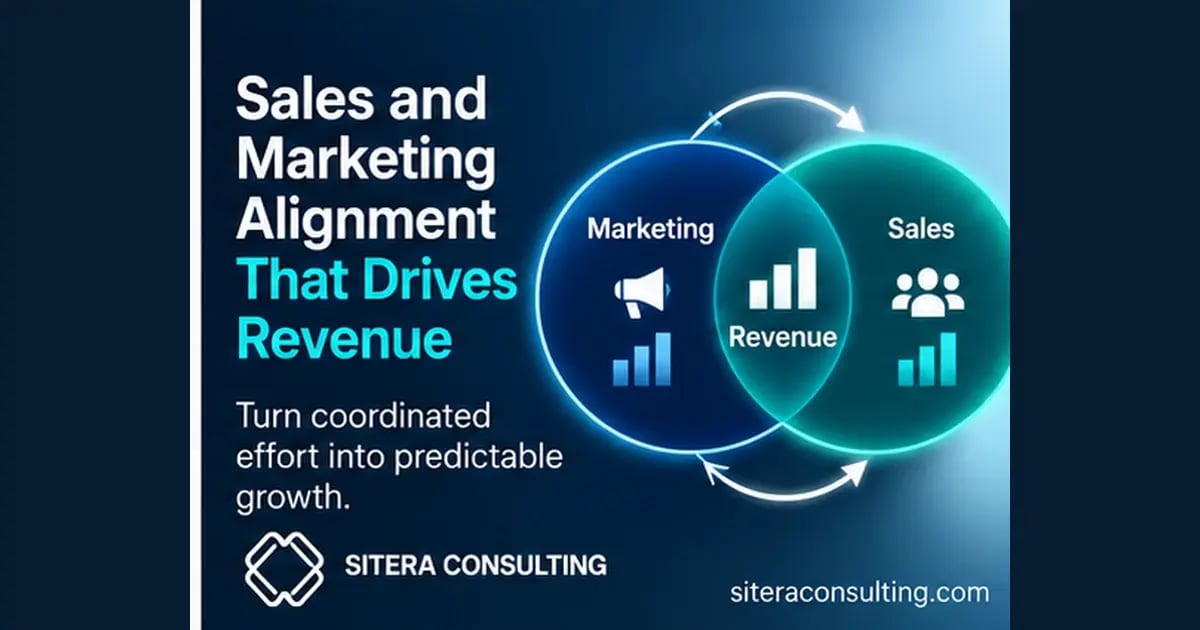
What sales and marketing alignment actually means
Alignment should connect decisions across customer targeting, positioning, demand creation, qualification, follow-up, opportunity progression, and measurement. Shared terminology is useful, but a shared definition of a marketing-qualified lead is not a substitute for evidence that those leads become customers.
Why alignment doesn't always improve revenue
Imagine marketing delivers its promised lead volume and sales contacts every lead within the agreed service level. Both teams meet their commitments. Yet few opportunities advance. The agreement is functioning; the assumptions behind it may be wrong. Perhaps the campaign reaches people who cannot buy, or the offer attracts interest without urgency.
Seven signs teams are aligned around the wrong outcomes
- Lead volume rises while qualified opportunities stay flat.
- Both teams celebrate meetings without measuring opportunity quality.
- Pipeline grows but win rates fall.
- Definitions match in presentations but differ in CRM workflows.
- Follow-up meets SLA targets but buyers receive irrelevant outreach.
- Attribution rewards a channel regardless of customer fit.
- Revenue targets are shared but no one owns the handoffs that affect them.
Start with the customer, not the handoff
If teams disagree about lead quality, examine the ideal customer profile and the actual customers who win, retain, and expand. Compare performance by segment, company size, use case, buying trigger, and source. Sometimes the apparent alignment problem is really a targeting problem.
Our existing article on TAM versus ICP explains why a broad addressable market is not the same as a prioritized customer profile.
Measure revenue outcomes across the full lifecycle
Useful shared measures include lead-to-opportunity conversion, opportunity acceptance, speed-to-lead, stage conversion, win rate, cycle length, average deal value, and sourced or influenced revenue. Segment those metrics by audience and acquisition source. A single blended conversion rate can conceal serious problems.
At Verbit, work connecting demand generation, sales development, and lifecycle reporting reinforced an important lesson: changing a dashboard alone doesn't change results. Teams need consistent definitions and an operating process that makes the data actionable.
Diagnose the cause before prescribing an alignment initiative
| Symptom | Investigate |
|---|---|
| High lead volume, low acceptance | Targeting, intent, qualification criteria |
| Accepted leads, few meetings | Response time, ownership, messaging |
| Meetings, few opportunities | Customer fit, buying need, qualification |
| Opportunities, few wins | Offer, differentiation, sales execution |
| Conflicting reports | Lifecycle definitions, CRM data, attribution |
What to fix before adding more campaigns
Choose the most consequential break in the lifecycle. Validate it using a sample of real records and conversations, not only aggregate reports. Then assign ownership, establish a baseline, make a focused change, and measure the downstream result.
For additional perspective on measuring meaningful outcomes, read Modern Demand Gen Metrics: Why MQLs Are Holding You Back.
When alignment isn't the underlying constraint
If both teams are executing consistently but revenue remains weak, investigate market, customer, offer, data, technology, and process alongside demand and sales. Sitera's Revenue Performance Diagnostic is designed to examine these connected causes rather than assume one department is responsible.
Schedule a conversation if you need to determine whether your revenue problem is alignment, execution, or something upstream.