.png?width=750&height=300&name=SITERA%20CONSULTING%20(Logo).png)
Companies are spending millions to make their marketing faster. AI can write more content, send more messages, score more leads, and lower the cost of doing it all.
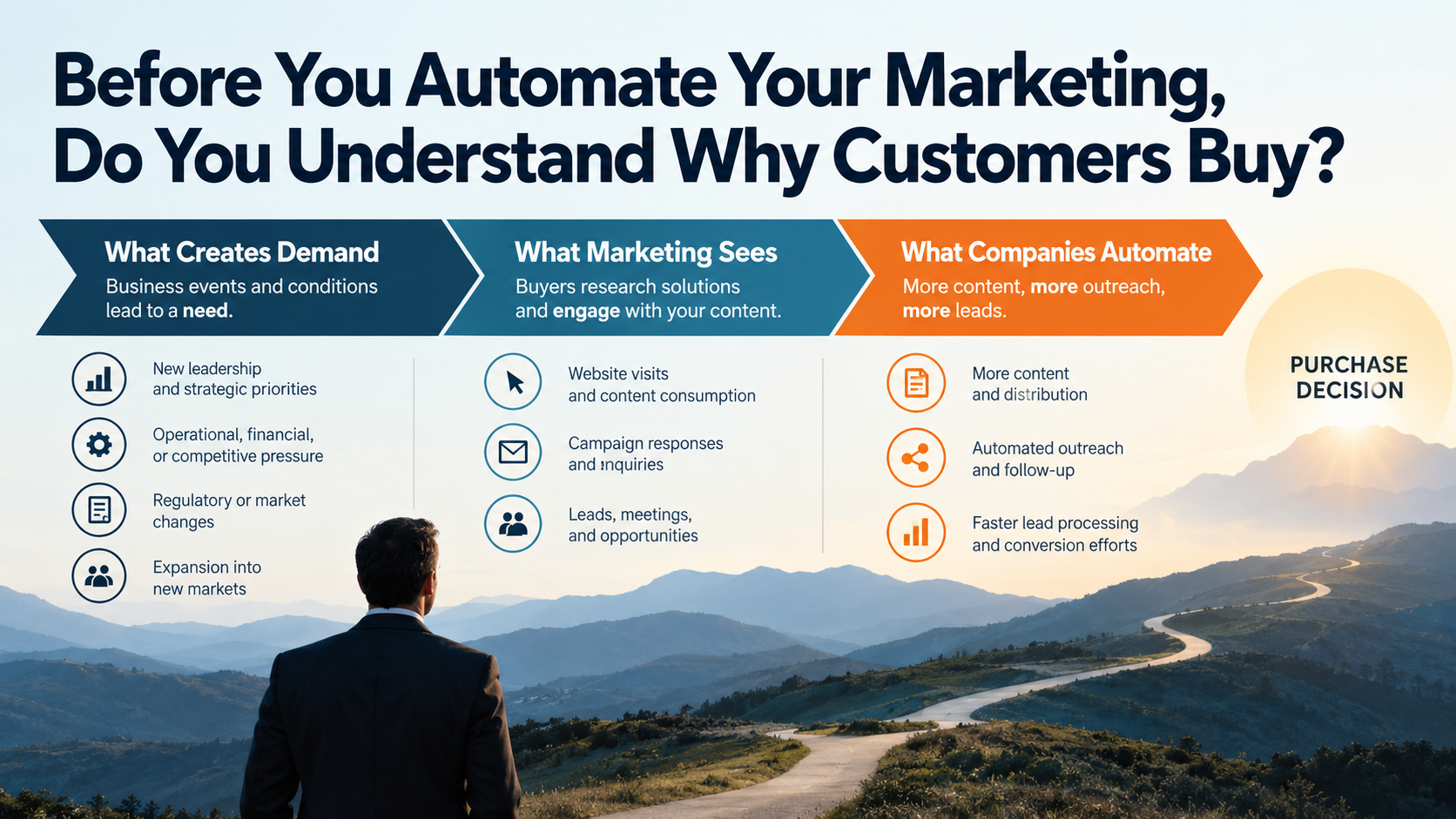
But what if the company doesn't understand what makes its customers buy?
More activity won't solve that problem. It may just make a weak strategy run faster.
Before automating another campaign, leaders should ask a harder question: Do we understand what changes in a customer's business before they decide they need us?
Do You Know What Actually Causes Customers to Buy?
Most B2B companies can describe their ideal customer. They know the industry, company size, job titles, and perhaps the technology their prospects use. Many can tell you which campaigns generated leads and which deals closed.
That's useful information. But it doesn't fully explain why a customer decided to act.
Two companies can look identical on paper. Both fit your ideal customer profile. One buys this quarter. The other does nothing for two years. What changed for the first company?
Perhaps a new executive arrived with a mandate to improve results. Perhaps a customer threatened to leave. Perhaps the company's existing systems could no longer keep up with growth.
Those differences matter more than another list of accounts that match your target market. The real question is not just who could buy? It is what would cause them to buy, and why now?
Demand Often Forms Before the Buying Journey Begins
Consider how a business problem develops:
- A new executive arrives.
- Revenue declines.
- A competitor gains market share.
- Regulations change.
- A strategic initiative fails.
- A customer complains to the right person.
None of these events requires a website visit or a demo request. Yet any one of them can start a chain of decisions that leads to a purchase.
Imagine a company receiving repeated complaints about slow customer service. At first, managers work around the problem. Then a major customer threatens to leave. The CEO asks what needs to change. A team reviews its processes and decides it needs new software. Only then does someone search for vendors.
The search didn't create the need. The business problem did.
I think of this as demand formation: the conditions, experiences, and interactions that cause a buyer to recognize a need and begin moving toward a decision.
Marketing and sales can play a part. A helpful article or thoughtful sales conversation may help an executive see a problem differently. But demand can also form long before a vendor enters the picture.
If we study only the visible steps of a buyer journey, we may miss the conditions that set it in motion.
Why Companies Misunderstand B2B Buying Behavior
Companies often know far more about customer activity than customer decisions.
They can count website visits, email responses, meetings, opportunities, and conversions. Those numbers tell us what happened in systems we control. They don't necessarily tell us what was happening inside the buyer's business.
Even a win analysis can mislead us if we look only at customers who purchased. The buyers who chose a competitor, delayed the decision, or decided to do nothing may reveal just as much.
Did the customer have a pressing business problem? Was the problem important enough to fund? Did leadership agree on what needed to change? Did the proposed solution address the real concern?
Those answers can challenge assumptions about who is ready to buy and which messages matter.
For example, a company might believe its strongest prospects are businesses of a certain size. A closer look might show that growth alone is not the trigger. The better signal could be rapid expansion combined with an outdated process and a new leader responsible for fixing it.
That insight could change targeting, outreach, content, and sales priorities. It could also change what the company decides to automate.
AI Can Make an Ineffective Marketing Strategy More Efficient
AI is excellent at helping teams do more with less. It can speed up research, draft content, organize data, and support outreach. Those are real benefits.
But efficiency and effectiveness are different.
If your target accounts are wrong, AI can help you reach the wrong accounts faster. If your messaging doesn't reflect a buyer's real problem, AI can produce more versions of a message that still misses the point. If you measure success mainly by activity, AI can make those activity numbers look impressive.
None of that guarantees better revenue.
Consider a leadership team that sees rising content output, more automated emails, and lower cost per lead. The dashboard looks better. Yet opportunities stall, win rates stay flat, and growth misses the plan.
The problem may not be the speed of execution. It may be the assumptions behind the strategy.
AI can make an ineffective process cheaper and faster. That doesn't make it a good process.
AI Could Also Help You Understand Why Customers Buy
There is a better use for AI than simply increasing output: use it to question what you think you know.
Start with past opportunities. Look beyond closed-won deals to losses, stalled decisions, and prospects who never bought. Examine the business problems customers described, the people involved, the timing of key events, and the reasons decisions moved forward or stopped.
AI can help organize this information, compare cases, and surface patterns that deserve a closer look. It might reveal that certain leadership changes, operating pressures, or customer complaints often appear before a buying decision.
But a pattern is not proof. Companies that buy may share characteristics with companies that never buy. Sales notes may be incomplete. Some important events may never appear in your CRM.
Use AI to develop questions and test assumptions, not to declare that you've discovered a perfect formula for purchasing decisions.
When paired with customer conversations and sound judgment, this work can improve an ideal customer profile and go-to-market strategy. It can also help leaders decide where automation is likely to improve results.
Five Questions Executives Should Ask Before Automating More
- What usually changes in a customer's business before they decide to buy? Look for pressures, events, and priorities, not just firmographic traits.
- Do we understand why customers choose us, choose someone else, or choose to do nothing? Include losses and stalled deals in the analysis.
- Are sales and marketing responding to those buying conditions? Ask whether your outreach helps buyers solve problems they actually recognize.
- Are we using AI to improve understanding or mainly to increase activity? More output is not the same as more demand.
- What evidence would show that our AI investments improve revenue performance? Look beyond speed, volume, and cost to the quality of opportunities and business outcomes.
Before You Automate, Understand What You're Building
AI gives companies new ways to scale marketing and sales. But scaling a strategy you don't understand is a risk, not a growth plan.
Before asking how much more your team can automate, ask what causes your customers to buy and whether your current approach reflects those conditions.
That's the kind of question Sitera Consulting's Revenue Performance Diagnostic is designed to help leaders investigate: where revenue performance breaks down, which assumptions need testing, and where investment may be missing the real problem.
Discover what your revenue system may be missing.